SORA: The simulator, is about to die. The Studio Was Just Getting Started.
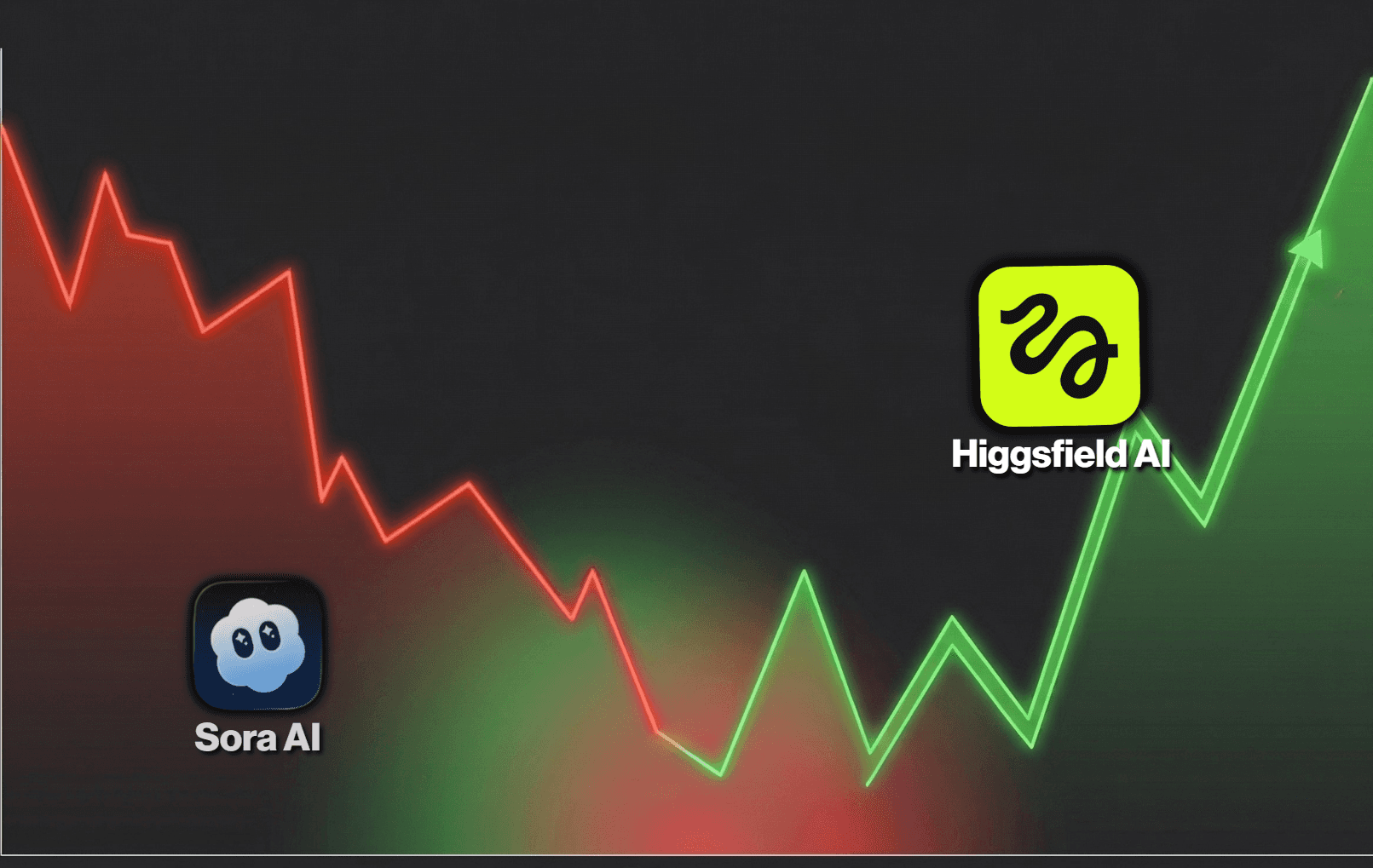
Same industry, same infrastructure — one had more money, the other had a better vision and a better aim. That's how Higgsfield grows, and that's how Sora died.
Imagine a system so powerful it claimed to replace cameramen, directors, editors, and the whole filmmaking crew. That was the quiet implication behind OpenAI's Sora. A system so powerful it promised cinematic video from a simple prompt. No cameras. No crews. No directors. Just computation doing what humans spent decades learning to do.
For a moment, the entire industry held its breath. Hollywood went quiet. Filmmakers started asking uncomfortable questions about their futures.
And then, on March 24th, 2026, the BBC confirmed what the numbers had been whispering for months: Sora is shutting down.
Weeks before its scheduled shutdown on April 26, a filmmaker in Detroit and another in Berlin — two people who had never met in person — won $100,000 for a short film they built together entirely through AI tools. Their audience thought it was a real studio trailer.
That contrast is the whole story.
The Real Reason Behind Sora's Shutdown: The "Black Hole" That Sora Built for Itself
OpenAI had already announced that Sora would shut down on April 26, making this moment less of a sudden collapse and more of a quiet phase-out.
Sora didn't fail because it lacked "wow." Anyone who saw it run knew it was technically extraordinary. It failed because it was architecturally built like a black hole — pulling everything in, letting almost nothing out.
Massive compute in. Rendering minutes of high-fidelity, physics-accurate video burned GPUs at a scale that the company itself struggled to describe without alarm.
Last November, the head of Sora told reporters that their GPUs were "melting." That wasn't a metaphor. That was a product manager watching the infrastructure buckle under its own ambition.
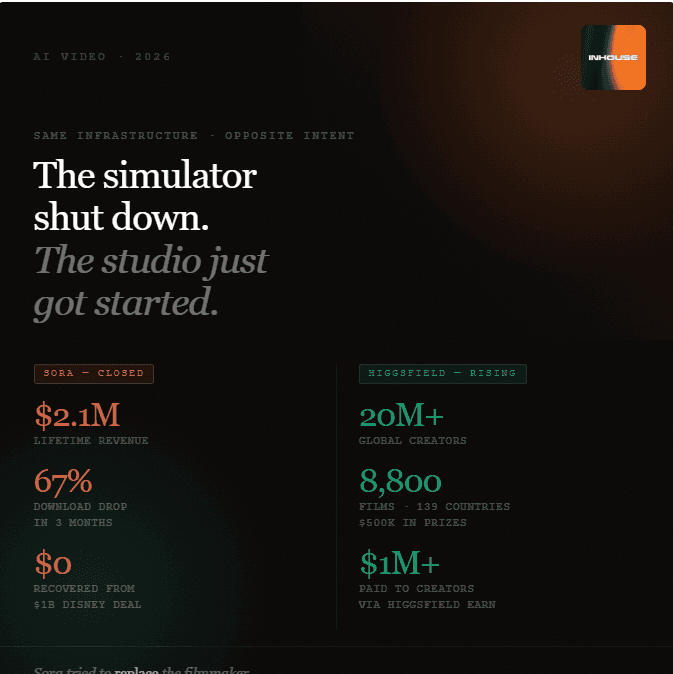
By February 2026, monthly downloads had fallen from a peak of 3.3 million to just over one million. The math was simple and brutal. Sora was a product in search of a business model, in a category where the compute costs don't forgive that kind of delay.

The Higgsfield Fix
While Sora was trying to replace the filmmaking process, Higgsfield AI was doing something structurally different — building the infrastructure to monetise the filmmaker.
Sora said: "I don't need you."
Higgsfield said: "I'll be working with you."
That shift in framing — from threat to tool — is what allowed Higgsfield to build something Sora never could: a community that actually wanted to be there.
Building the Distribution Line
Sora: Prompt → Video Generation → Download → Leave
Higgsfield built the home. Their platform now serves over 20 million creators globally, with their own community hub, streaming layer, and competition infrastructure.
The Vertical Power Move
Through Higgsfield Earn, they built a marketplace that connects global brands directly to AI filmmakers. This isn't a feature — it's an economy. The platform has paid out over $1 million directly to creators, plus distributed over $3 million in platform credits. Creators on the platform have landed contracts with Fortune 500 agencies, NBA teams, and major fashion houses.
The Infrastructure Move
Sora bet everything on one extraordinarily expensive proprietary model. When the physics didn't work, the whole video didn't work. Higgsfield took the opposite approach — acting as an aggregator, letting creators choose the most efficient engine for each job, running on a credit-based model that scales revenue directly with usage.
No blank-cheque compute burn. No "GPUs melting." Just a cost structure that makes sense.
And the Result?
This month, Higgsfield released results from the largest AI filmmaking competition ever held. Nearly 8,800 submissions. 139 countries. A $500,000 prize pool distributed to independent creators — people with visions but not studio budgets.
India sent 1,805 films. The United States sent 1,041.
The CEO of Higgsfield put it plainly:
"The next great blockbuster franchise won't necessarily come out of LA or Paris. It can come from anywhere on Earth."
That is not a marketing line. That is a structural claim about who gets to make things now — and it is backed by 8,800 data points from people who showed up and proved it.
Key Takeaways: Why the Studio Beat the Simulation
Distribution is the ultimate moat. A powerful model means nothing without a destination. Higgsfield didn't wait for YouTube to adopt them — they built the stadium, sold the tickets, and now pay the players.
Empowerment outlasts automation. Sora tried to make the filmmaker irrelevant. Higgsfield created a new career class — the AI Director — and built a direct path to income for them. One orientation built resentment. The other built a community of 20 million.
Unit economics are non-negotiable. Scaling a world simulator is a research project. Scaling a revenue-generating ecosystem is a business. The credit-based, aggregator model isn't glamorous — but it's the reason Higgsfield is still standing.
Final Thought
Sora showed us what AI could do if money was no object.
Higgsfield is showing us what AI does when you build an industry around the people who actually make things — and give them the tools, the platform, the competition stage, and the paycheck to keep going.
The simulator is gone. The studio is just getting started.